
What didn’t you do to bury me / but you forgot that I was a seed. —Dinos Christianopolous
What do you think?
Have you noticed an increase in the frequency of discussions about Black joy? I certainly have and I love it. Knowledge of any topic, across moving time, shifts, grows, evolves, on a spectrum: you’ve never heard of it before; you’re kinda familiar; you’re very familiar and at the forefront of that topic. And another axis of another spectrum overlayed across moving time: you probably will not keep up with the topic; you’ll monitor the topic loosely; you’ll (continue to) follow closely; you’re at the forefront as part of the evolution of that topic; you’re generating subtopics. Another spectrum and axis: knowing about or learning about the existence of this topic makes you happy; makes you pissed; makes you hopeful; smug; confused; avoidant…what does it make you feel, what does it make you think?
When you hear the term Black joy, how do you feel? Why do you feel that way? Is how you feel about the topic how you want to feel or how you expected you would feel? Had you ever considered how you would feel about the topic of Black joy?
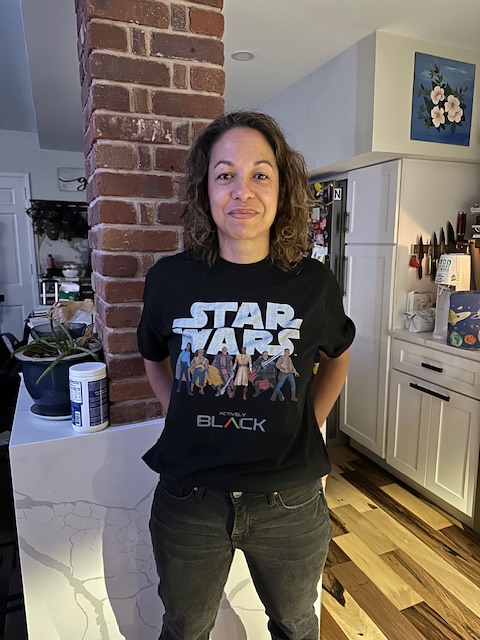
This is some of what I think
When I hear the term Black joy, some of the things that come up for me? First, how solidly multiracial I feel. Hybrids unite! I understand the very specific choice: Black joy. I appreciate it, I support it, it is me, it is my heritage and I still feel the pull to include my other dimensions. Trust Black women, stop killing Black people, protect Black children. I feel that deeply. That is me. And I am also a brown person. I am brown because for the most part, my mom is white and for the most part, my dad is Black, because of history, because of legacy that somewhere in my family some French, English, Native North American, continental African and Iberian folks got together and had kids. And for the most part, like Barack Obama, when viewed through the lens of less nuanced and impatient eyes, through the lens of enduring racial hierarchy dominance, I, too am Black.
The term Black joy is important to me, it’s life giving, it’s taking a stance, it’s taking psychophysiospiritual space and it’s an invitation. It’s an invitation into the past: our collective past, my past. It’s an invitation to the now of what’s always been here, and it’s an invitation into the future. Black joy. And, I love an invitation. I do. I say yes to that invitation.
When I hear the term Black joy, I feel ancestral. I connect into hundreds of years of people I do not know, but who are family. many were brought to this land where I now live and survived, many lived all over the globe and many still were born where I was born. Black joy and the ancestral connection means we survived, thrived, changed the physical landscape, dreamed, hoped, infused knowledge further ancient still than they, amalgamated knowledge to adapt, joked, invented, fought, created…created life, changed the trajectory of their families in ordinary ways and in ways that historian Stephen Greenblatt would describe as a swerve—forever changing the course of human history. Black joy is in part a bucking of a long oppressive demand, the insistence to only see Black people as cowered, as lowly, as fearful, as surviving on scraps in order to maintain a fairytale of “better,” of “superior”. Black joy is part of the lived experience passed down to me by a familial current; it is the truth of an existence, one which understands and understands deeply the fairytale told and reproduced by others to justify depravity and understands that fairytale is quite literally, the farthest from the truth.
I think my white grandmother would have read these books.
A literary genre that I love is the Victorian and historical romance novels featuring Black female protagonists. I love them because my Meme loved romance novels. She had dozens of books with Fabio on the cover all over her bedroom in Massachusetts. Even when I got older and I was allowed to read them, I never did, but seeing this very old (and very profitable) literary genre emerge melanated, makes me so happy. I love that melanated Victorian and historical romance novels have uncovered yet more racists. Exposing racists is important and I am not sure these talented writers would have predicted that would be a consequence of their art. These racists demand there was only one way Black people showed up in history and therefore historical fiction and it is as enslaved, as illiterate, as poor and how dare these authors alter the facts and allow these characters to have dignity, and experience love and desire.
I love when racists are confronted with the reality of a whole group of people that they just cannot comprehend, period, let alone comprehend expansively, let alone comprehend that their comprehension is faulty to begin with. They get very uncomfortable. And like in the case of Black people singing country music, demand their racist comfort be considered and the offending narrative be rewritten to fit the fairytale they were told. And quite literally fairytale with the Little Mermaid being reimagined as brown, or Captain America as Black. The anger, the hatred that rises to the surface. I wonder if those people are ever shocked by their own anger. Not just their anger to maintain the fable they were told about racial hierarchy and history, and art, but just their anger in general…I wonder.
We could just assume dignity for everyone…we could.
At Food Recovery Network, one of my most constant messages, and one of my favorite messages is to remind people that, in chronic hardship people have found joy. They have. They have found ways to make art, to share their possessions, their shelter, their food, their hope. Even in chronic hardship, people maintain their dignity, their humanity, their capacity to love, their ability to wish better for others, to trust. I invite people, who may not otherwise, to think about the daily life of people who do not have the consistent access to the food they deserve and consider how similar we all are; some of us just have the food we deserve while others of us do not. In all of us are the same capacities, why wouldn’t there be? And in situations, some of us are able to still live as fully as we can with less. Living fully is the option taken. Joy is sought out.
James Baldwin discussed the concept throughout his writing and debates of the [learned, maintained, reproduced] ability/function of the dominant not to consider the lives of those constructed as other, as less than. He noted the complete lack of interest or consideration an entire group of [white] people had for an entire other [Black] group. It’s quite remarkable when you really think about what that means. And of course, he notes the other side of the dominant mindset: their assumption that all other groups not in their dominant group want to be in the dominant group…and the terror (often manifested in the form of racialized violence) when the dominant realizes that is not the case for many outside of the dominant group.
Some people are interacting with the concept for the first time in their lives that, during hundreds of years of genocide, suppression, oppression, violence, betrayal and lies, that people were able to find…joy. Today, some people are seeing videos come across their Instagram feed, or the nightly news, or in musical collaborations that are saying…huh…Black people are happy. For the first time, some people are considering that.
When I think about Black joy, I feel protective.
When I think about Black joy, I think about all of the things out there in the world to consider, to try, to see, to touch, to write about, to talk about, to smell— I feel revolutionarily ordinary. I feel the gift of the day, the invitation of just today, and I accept with love and with joy.

 Hybrid Nation