“WHEREAS, the N-word has been established to be derogatory, degrading, dehumanizing and is one of the most offensive words in history…” –NAACP*
I won’t say anything other than “the n-word.” I will not say the full word hard “r” and I won’t say the full word ending in “ga.” I alsoI won’t write it out. I do not remember exactly when I made the decision to not say or write out the n-word, but it was a very long time ago. It was after my family moved to Maine, but well before I moved out of my parents’ house. And, the decision didn’t take any degree of back and forth, should I or shouldn’t I, could I or couldn’t I? The decision was that I wouldn’t and there was no internal debate for me, and that’s the way it’s always been.
I was reunited with my decision, that saying and writing the n-word was anathema to me when I decided to tell the story about the first time I was called…the n-word. I had made my decision long ago and had very little reason to articulate my decision to anyone. A silent decision and understanding. As much as I talk about race, my decision to not say or write the n-word across all these many years just never needed an explanation. When I was a young adult at the University of Maine at Augusta and I wrote papers about the creation of “the other,” to symbolize miscegenation and the fear of Black men having sex with white women, my personal stance on the n-word was not needed. Later, at CMU, I wrote papers about how race was created in the United States and spread across the world and my opinion on the n-word was not necessary then, either.
Before my time in academia helped to shape my understanding of race in the United States, my lived experience in Maine, in a bi-racial household, in the 90s, had a much longer headstart on shaping my understanding of race. Growing up in Maine, I was surrounded by white people, and a lot of the time, I was surrounded by a lot of well meaning white people (iykyk, and if you don’t know, perhaps I’ll talk about my interactions with well meaning white people another time.). My only deep connection to Black people were my stepdad and my brothers. By the time we moved to Maine, my contact with my bio dad was completely shut off. I also kinda knew my stepdad’s friend who first pioneered the move from Massachusetts to Maine that we followed. My stepdad’s friend was Black and also married to a white woman, and had three or four kids. The youngest two sons attended the same school as me at one point for a brief period of time and with whom, at least while at school, I had almost zero interaction with.
All of my teachers were white growing up (in Massachusetts they were also all white), and my closest friends were white; the people who worked at any store I went to were white, the rare times my mom took my sister and me to get Pizza Hut, the people also at Pizza Hut were all white. Almost everyone around me was white. And among the white people I was closest to, they just did not say the n-word and it was categorically not okay to say that word.
My stepfather grew up in the South as a child and a young man before he joined the roughly 6 million Black people leaving the South at the tail end of the Great Migration. Whenever my stepfather spoke the n-word, which was not frequently, it was incorporated into one of his long sermons I was made to endure. He told me, as soon as I leave his house, when people see me, they won’t know me from anyone else, and they would only see me as an n-word on the street. That’s it. At the same time I received more data points that the n-word was a slur, it was fearful, it was rude and it was not for me to say, I was also so confused. I was confused that he would talk so negatively about how…all of the people around us…perceived me…and that he brought us to this place with all of these white people. And, the people I knew were nice.
As a young kid who followed the rules, for me, it wasn’t a hard decision to make to not say the n-word. My limited exposure overwhelmingly said the word was bad and unsayable. Almost all of my friends were white and we certainly weren’t going to say it together as acts of quiet rebellion like we said shit and all conjugations of fuck among ourselves. My older brothers, who were first among us siblings to be exposed to cultural movements taking the n-word back as powerful, as community, as a word for us, if they did say it among their peers, they certainly were not going to drop the slang word to their much younger sisters. No one I looked up to said the word as an act of belonging.
The long history in the United States of the n-word…it’s deeply sad; troubling; it’s so traumatizing. The endurance of the word as a weapon against Black and brown people from our earliest time on this continent to the present moment makes me angry and rageful. I don’t know if I hate the word as much as Tybalt hates all Montagues or ironically as much as Iago hates the Moor, but it’s probably pretty close. I do not daydream about situations in which I’m called the n-word as an adult where I respond with violence. I happen to not daydream about any situation where I respond with violence. And I often question if I daydream at all. In the instances I have seen Black people called the n-word as an act of violence, I understand deeply the reply of physical violence. And when I see Black people who have replied with physical violence from being called the n-word, I ain’t mad.
For taking power back, as slang for groups within the Black and brown community, in music and movies by and for Black people, for Black comedians and Black artists, I do not hate it, and I understand its use and I appreciate its use. I have zero problems with its use, and appreciate its full use and not an ersatz version, a lower impact version that I use. As my husband would say, “it is what it is,” and I’ve always been okay with that. There is no longing here or wishing things could be different.
The movement of the n-word, the changes the word has undergone over time I find fascinating and important. I appreciate the cultural offerings this change over time has produced. I applaud the not so small feat it took for us to take the word back for us. There are many elders who never approved of Black and brown people using the n-word, calling one another the n-word as displays of love and community and also displays of aggression and anger toward one another and toward a larger, less defined entity as in, fuck this shit. And while all of that reappropriation was happening, there was still the hypervigilance happening that said this word is not for white people and any use of the n-word by white people toward a Black or brown person is an act of violence. All of this is fascinating, it’s deeply interesting, it’s deeply moving.
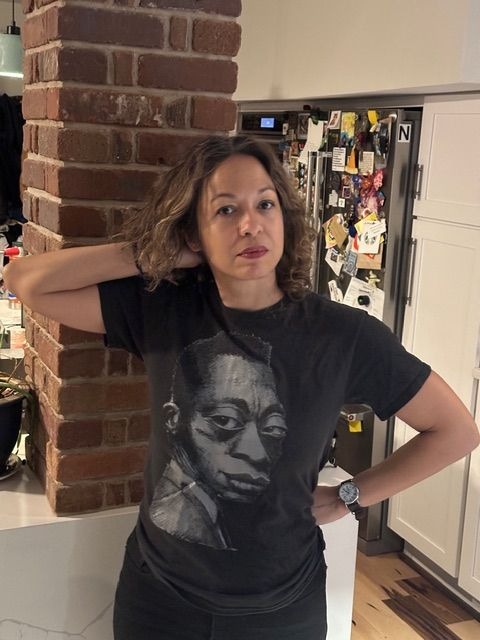
I’m moved by how this word is used for community, for belonging because for me, whose only home teaching about race came from my Black stepfather and sometimes my white grandmother, but definitely not my white mother, who grew up in the day-in-and day-out of a white state in a white county, in a white rural city (is that possible? Technically designated a city, but with horses and cows and lots of pastures all around?), at a white school learning a white version of history and a white literary cannon where I was taught and where I understood as James Baldwin understood when he said, “you never had to look at me. I had to look at you. I know more about you than you know about me,” the n-word belongs to me whether I take it up in its entirety or not.
When I decided to tell the story of the first time I was called the n-word, I made the decision to write “the n-word.” And I understood that for me as the writer, the n-word is simulacrum to the full word. The impact of what happened to me won’t be as sharp as it could be when I write “the n-word.” I know that it won’t and that is okay with me. It’s okay with me because my decision stands that with this word, I just won’t. I also am the kind of writer who trusts my readers. I understand many of you reading my story will incorporate your own understanding of the n-word as a slur, as a weapon, as a threat to Black and brown people. And that is how I want you to read my story. I will ask you to suspend your overall understanding of the word as one used by many as community, as lighthearted, as power producing and all of the positive ways the word has come to mean. And while you are reading my story I will ask you to hear the word and see the word used against me as a threat, as a weapon, as terror, because that is what it was.
Back to James Baldwin. How familiar are you with James Baldwin? To me, no matter where you are on the spectrum of familiarity with James Baldwin, in my opinion, it is mandatory to watch the 2016 documentary, “I Am Not Your Negro” directed by Raoul Peck. In this documentary, you will hear him say the sentence I quoted above, which also comes from Baldwin’s collection of essays, “No Name in the Street,” published in 1972 that I have yet to read but will because I believe Baldwin’s oeuvre is mandatory. I believe it is mandatory to listen to the 1965 debate between James Baldwin and William F. Buckley, “Has the American Dream been Achieved at the Expense of the American Negro?” If you’re not familiar with William Buckley, he opposed Civil Rights legislation and believed in racial segregation in the United States and apartheid in South Africa. It wasn’t until the 1963 horrific act of terrorism of the bombing of 16th Street Baptist Church in Birmingham Alabama that killed Addie Mae Collins (age 14), Denise McNair (age 11), Carole Robertson (age 14), and Cynthia Wesley (age 14) that Buckley began to change his mind about his racist views.
I also request that you watch the 2021 documentary, “The Summer of Soul” directed by Ahmir “Questlove” Thompson, about the Harlem Culture Festival of 1969.


